In the high-pressure world of B2B SaaS, the boardroom is often a battlefield between two philosophies: the "I need leads now" camp and the "we need to build a brand" camp. This tension is the fundamental divide between Lead Generation and Demand Generation.
Most Series A and B startups are suffering from a "Leaky Bucket" syndrome. They pour millions into Lead Gen, buying lists, gating mediocre whitepapers, and harassing "MQLs" that have zero intent to buy, only to wonder why their LTV:CAC is underwater and their sales team is burnt out.
At Vanderbuild, we see this daily. The truth is that Lead Generation without Demand Generation is just expensive spam. Conversely, Demand Generation without Lead Generation is just expensive "brand awareness" that doesn't pay the bills.
This 20,000-character manifesto is the definitive guide to ending the civil war between these two functions. We will explore the technical architecture, the economic mathematics, and the strategic frameworks required to build a balanced, high-velocity revenue machine in 2026.
In this article, you will learn:
- The Revenue Math: How to calculate the "Efficiency Gap" between the two models.
- The Gated vs. Ungated Debate: When to give knowledge away for free.
- The Signal-Based Selling Framework: Moving beyond the "MQL" to "High-Intent Signals."
- The Dark Social Layer: Tracking Demand Gen in an un-trackable world.
- Budget Allocation by Stage: How to pivot from Seed to Series C.
- The Tech Stack: Connecting Clay, 6sense, and your CRM for a unified view.
I. The Strategic Definitions: Beyond the Buzzwords
To fix your GTM, you must first define the terms with surgical precision.
1. Demand Generation: The "Why" and "How"
Demand Generation is the holistic strategy of building a brand, establishing thought leadership, and creating a "Pull" effect. It targets the 95% of your market that is currently not "In-Market" to buy.
- Goal: To make your company the "obvious choice" when the prospect eventually enters a buying cycle.
- Tactics: Podcasts, LinkedIn content, ungated templates, PR, and SEO that focuses on "Problem Awareness."
2. Lead Generation: The "Who" and "When"
Lead Generation is a subset of Demand Gen. It focuses on the 5% of the market that is actively searching for a solution. It is a "Push" tactic designed to capture data for the sales team to act upon.
- Goal: To convert interest into a trackable record (Lead) that can be nurtured or closed.
- Tactics: Gated webinars, "Request a Quote" forms, paid search for "bottom-of-funnel" keywords, and outbound waterfalls.
II. The Economic Framework: The Math of Efficiency
The primary reason to balance both is the Total Cost of Acquisition. If you only do Lead Gen, your CAC will skyrocket because you are competing for the same 5% of "active" leads as everyone else. This leads to a bidding war on Google Ads and a "Spam War" in LinkedIn Inboxes.
The Efficiency Gap Formula
At Vanderbuild, we use this LaTeX-based model to show the ROI of Demand Gen on Lead Gen efficiency:

Where the Brand Multiplier ($M > 1$) represents the increased trust and decreased sales friction generated by Demand Gen.
The Unit Economics Comparison
III. The "MQL" is Dead: Long Live the "High-Intent Signal"
The traditional Lead Gen model relied on the MQL (Marketing Qualified Lead). A person downloads a PDF, gets 10 points, and an SDR calls them 3 minutes later. In 2026, this is considered harassment.
The Signal-Based Revolution
Balanced GTM teams combine "Lead Scoring" based on downloads and Signal-Based Selling. This is where Lead Gen meets Demand Gen.
High-Intent Signals to Capture:
- The "Vanderbuild" Champion Move: A former user of your software just changed jobs and moved to a new company (captured via Clay/LinkedIn).
- Product-Led Signals: A free-trial user just invited three team members to their workspace.
- Technographic Shifts: A target company just stopped using a competitor and started using a complementary tool.
- Dark Social Engagement: A prospect from a Target Account has shared your podcast episode internally (tracked via intent tools like 6sense or Koala).
IV. Demand Generation: The Art of the "Ungated"
The most controversial part of the Vanderbuild Standard is our stance on gating content. Gate less, educate more.
The "Content Friction" Logic
If you gate your best knowledge behind a form, you are optimizing for Contact Info, not Knowledge Distribution.
- The Lead Gen Way: 100 people see your ad. 5 people fill the form. 95 people never learn your value proposition.
- The Demand Gen Way: 100 people see your ungated content. 60 people read it. 10 people share it. 2 people come to your site and book a demo (High-Intent).

Vanderbuild Recommendation: Gate only what is truly "proprietary" or high-value (e.g., a custom ROI calculator or a 5-day certification). Give away your "How-To" guides, your frameworks, and your case studies for free. This builds the "Brand Moat" that makes Lead Gen 10x easier later.
V. Lead Generation: The Sniper Execution
While Demand Gen is the "Air Cover," Lead Gen is the "Ground Force." Once the market is aware of the problem, Lead Gen must be executed with surgical precision using Waterfall Enrichment.
The Modern Lead Gen Workflow (The Clay Stack):
- Identify: Use intent data to see which companies are "Heating Up."
- Enrich: Use a Clay waterfall to find the specific decision-makers (CFO, VP Sales, etc.).
- Validate: Ensure emails are 100% verified to protect deliverability.
- Segment: Don't send a generic pitch. Send a message that references the "Demand Signals" (e.g., "Saw you were discussing [Topic] on our CEO's LinkedIn post...").
VI. The Balancing Act: Budget and Resource Allocation
How you balance these depends entirely on your company's stage. There is no "one size fits all" ratio.
The Vanderbuild Allocation Matrix
The "Death Spiral"
Most companies fail because they flip the ratio too early. They hit a Series A, the investors demand "Leads," and they move to 90% Lead Gen. They burn through their TAM (Total Addressable Market) in 12 months because they stopped creating new demand.
VII. Attribution: Solving the "Dark Social" Problem
The biggest challenge in Demand Gen is that it is hard to measure. If someone listens to your podcast on Spotify and then types your URL into Chrome a week later, HubSpot will call that "Direct Traffic."
1. The Self-Reported Attribution (SRA)
This is the single most important tool in your hygiene stack. Add a mandatory, free-text field to your "Book a Demo" form: "How did you hear about us?"
What you will see:
- "Heard your VP on the [X] Podcast."
- "Follow [SDR Name] on LinkedIn."
- "Recommended in a private Slack community for Founders."
The Result: You can now prove that your "Ungated" Demand Gen spend is actually driving your highest-value "Lead Gen" outcomes.
2. Multi-Touch vs. Last-Touch
Stop using "Last-Touch" attribution. It always over-favors Lead Gen (Google Ads) and under-favors Demand Gen (Content). Use a linear or U-shaped model to give credit to the initial "Problem Awareness" touchpoints.
VIII. The Role of the "Creator-SDR" in 2026
The line between Demand and Lead Gen is blurring most significantly at the SDR level. In the old model, SDRs were Lead Gen robots. In the new model, they are Demand Gen Micro-Influencers.
The Vanderbuild SDR Blueprint:
- Demand Task: Spend 30 minutes a day commenting on prospect posts and sharing insights.
- Lead Task: Use Clay to run waterfalls on those who engaged with their content.
- The Result: The outbound "Lead Gen" email is a continuation of a "Demand Gen" conversation.
IX. The Tech Stack: Bridging the Divide
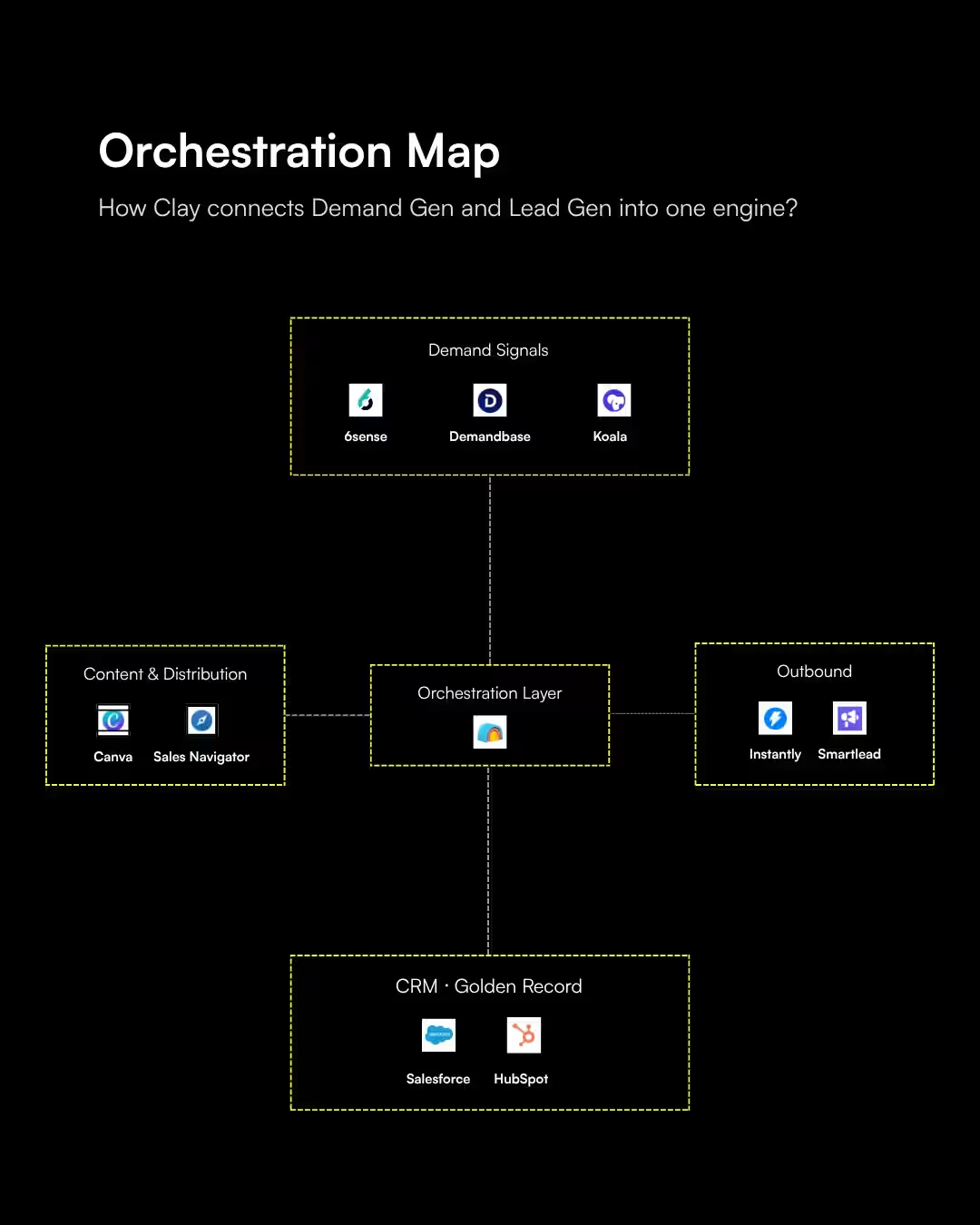
A balanced GTM needs a stack that talks to each other. If your Lead Gen tools don't know what your Demand Gen tools are doing, you'll provide a disjointed customer experience.
1. Demand Gen Stack:
- Content: Riverside.fm (Podcasts), Canva (Visuals).
- Distribution: LinkedIn Sales Navigator, Shield (LinkedIn Analytics).
- Intent: 6sense, Demandbase, or Koala (To see who is "Browsing" ungated content).
2. Lead Gen Stack:
- Data: Clay (The Orchestration Layer).
- Outbound: Instantly.ai or Smartlead.
- CRM: HubSpot or Salesforce (The "Golden Record").
X. Common Pitfalls: The "Lead Gen Trap"
Why do so many smart people fail at this?
1. The "Short-Termism" Trap
Founders under pressure often demand "Leads today." This forces Marketing to turn on "Bottom-of-Funnel" ads. This works for 3 months until the CPC (Cost Per Click) triples and the TAM is exhausted.
2. The "Friction" Trap
Gating every single asset. If you make a prospect fill a form to see a 1-page case study, you are telling them: "My data capture is more important than your education." This kills Demand.
3. The "Silo" Trap
Marketing does Demand Gen (Brand) and Sales does Lead Gen (Outbound), and they never talk. The SDRs send emails that have nothing to do with the brand's core message.
XI. Tactical Deep Dive: The "Webinar" Hybrid
A webinar is the perfect example of how to balance both.
- Demand Gen Phase (Pre-Webinar): 2 weeks of ungated LinkedIn posts sharing "Insights" from the upcoming webinar. You are educating the market regardless of whether they register.
- Lead Gen Phase (Registration): The form to attend. You capture the data.
- Demand Gen Phase (Post-Webinar): Sending the ungated recording and "Clips" to everyone, including those who didn't attend.
The Result: You get the leads (Contact Info), but you also build massive brand equity with the 90% who were too busy to show up but watched the 2-minute "Highlight Reel" on LinkedIn.
XII. Scaling to Enterprise: When Demand Gen Wins
In Enterprise SaaS ($100k+ ACV), Lead Gen actually becomes less effective as you scale. You cannot "Lead Gen" your way into a Fortune 500 company through cold emails alone.
Enterprise sales require Institutional Trust. This is built through years of Demand Gen, being seen as the "Safe Choice." In the Enterprise world, Lead Gen is simply the final "Closing" mechanism (The RFP or the Executive Dinner), but Demand Gen did 90% of the work over the preceding 12 months.
XIII. The Future (2026): Signal-Based GTM
As we look toward the end of the decade, the distinction between "Demand" and "Lead" will disappear into a single function: Signal-Based GTM.
Systems like Clay will allow us to see a Demand Signal (e.g., "Company X's CEO just complained about [Problem] on Twitter") and instantly trigger a Lead Gen workflow (e.g., "Enrich the CFO's email and send a personalized Loom video addressing that specific problem").
This is the "Holy Grail" - where brand-building and data-capturing happen in the same 60-second window.
XIV. FAQ: Practical Balancing Questions
Q1: I have a $5k monthly budget. Where do I start?
At $5k, you cannot afford high-intent Lead Gen ads. Put $4k into Demand Gen (Content, organic social, and small-scale creator partnerships) to build an audience. Use the remaining $1k for a Clay subscription to "Snipe" the people who engage with that content.
Q2: How do I tell my investors I’m moving away from MQLs?
Show them the "Closing Ratio." Explain that 100 leads with a 1% close rate is more expensive than 20 leads with a 20% close rate. Focus on Pipeline Velocity, not Lead Volume.
Q3: Should my CEO be doing Demand Gen?
Yes. In B2B SaaS, the CEO is the "Chief Demand Officer." People follow people, not logos. A single viral post from a CEO can generate more demand than a $50k/mo Google Ads budget.
Q4: When should I "Gate" a piece of content?
Only when the value of the content is higher than the "Pain" of the form. A "State of the Industry" report with original data? Gate it. A "Product Comparison" sheet? Ungate it.
Q5: Can Outbound be Demand Gen?
Yes, if the outbound is "Value-First." If you send an email saying "Here is a free audit of your site, no strings attached," you are building demand for your solution. If you say "Book a demo now," you are doing traditional Lead Gen.
XVI. Conclusion: The Vanderbuild Philosophy
Balance is not a 50/50 split of time; it is a 50/50 split of mindset. Every time you launch a campaign, ask: "Am I trying to find a person who is ready to buy now (Lead Gen), or am I trying to make the person ready to buy (Demand Gen)?"
If you do only the former, you will eventually run out of people. If you do only the latter, you will eventually run out of money. The most successful SaaS companies of the next decade, the ones that will reach $100M+ ARR, are those that treat Demand Gen as the "Product" and Lead Gen as the "Checkout Counter."